Product Introduction
-
-
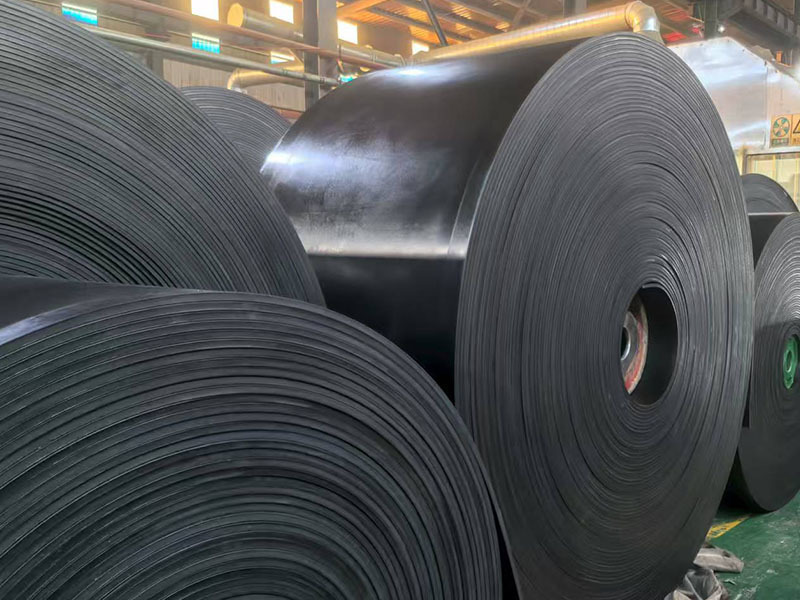
Features and Applications: Heat-resistant conveyor belts consist of a multi-layer core made of canvas materials such as polyester-cotton or polyester, along with a cover rubber that exhibits certain heat-resistant properties. They are widely used for conveying hot materials in industries including metallurgy, building materials, coke production, casting, and chemical engineering.
Heat-resistant conveyor belts are classified into four grades according to different test temperatures:
T1—Test temperature not exceeding 100℃.
T2—Test temperature not exceeding 125℃.
T3—Test temperature not exceeding 150℃.
T4—Test temperature not exceeding 180℃.
Standard: GB/T 20021-2017 “Heat-Resistant Conveyor Belt with Canvas Core”
Main Performance and Specifications
Physical Properties of Heat-Resistant Coatings T1 T2 T3 T4 Permissible deviation range Allowable range of variation Hardness Difference between post-aging and pre-aging (IRHD) +20 +20 ±20 ±20 Maximum value after aging (IRHD) 85 85 85 85 Tensile strength Performance Change Rate / % -25 -30 -40 -40 Minimum value after aging /MPa 12 10 5 5 Elongation at break Rate of change after aging / % -50 -50 -55 -55 Minimum value after aging / % 200 200 180 180
-
Heat-resistant conveyor belt
Heat-resistant conveyor belts consist of multiple layers of heat-resistant rubber cover and a fabric carcass, and are widely used in industries such as metallurgy, building materials, coke production, casting, and chemical engineering.