Roller
The deflection roller, also known as a guide roller or follower roller, is an essential and indispensable component in belt conveyor systems. Its primary functions include changing the running direction of the conveyor belt, increasing the wrap angle between the belt and the drive roller, or…
Email: info@shenzhenconvbelt.com
The deflection roller, also known as a guide roller or follower roller, is an essential and indispensable component in belt conveyor systems. Its primary functions include changing the running direction of the conveyor belt, increasing the wrap angle between the belt and the drive roller, or tensioning the belt to maintain adequate tension.
Unlike drive rollers, redirecting rollers do not provide power themselves; instead, they rotate passively under the push of the conveyor belt. The redirecting rollers manufactured by Hebei Xinyuan feature high load-bearing capacity, flexible design, and excellent durability, ensuring stable and efficient operation of conveyor systems.
Product Introduction
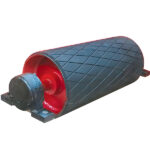
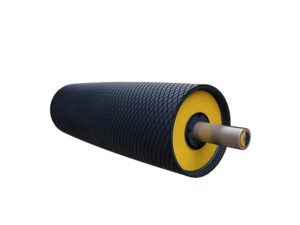
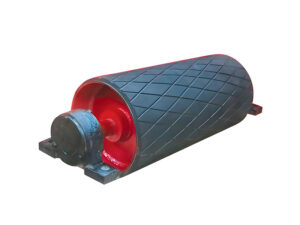
The structure of the redirecting roller is similar to that of the drive roller, but it typically does not have a rubber coating or uses a smooth-surface rubber coating, as it primarily experiences compressive and bending loads. Its main components include:
• Cylinder shell (housing): Made by welding high-quality carbon steel coils, it has sufficient thickness and rigidity to withstand the pressure from the conveyor belt.
• Shaft: Made of high-strength alloy steel, it supports the entire roller and withstands bending moments from the conveyor belt.
• Spoke (hub): The core component that connects the rim and the axle, ensuring efficient force transmission. Connection methods include welding and shrink-fit coupling.
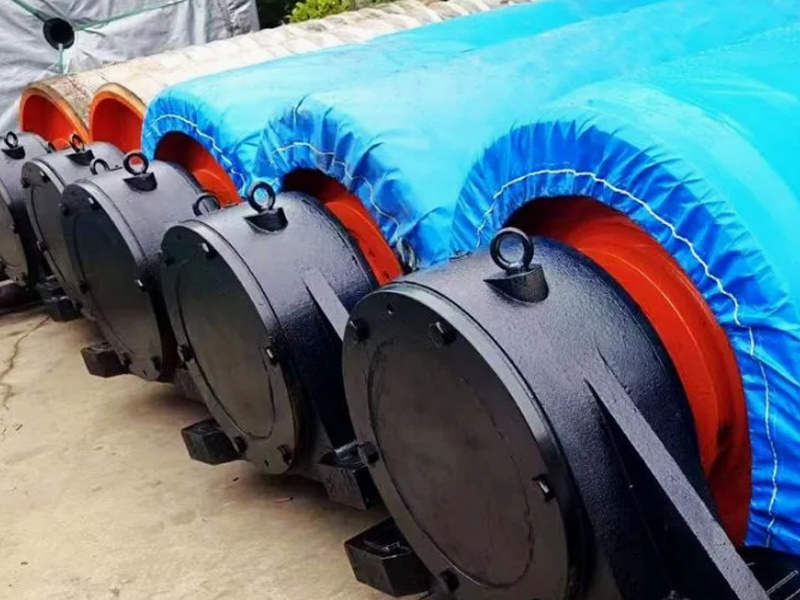
• Bearing housing: Equipped with high-quality self-aligning roller bearings that ensure the drum rotates smoothly even in the presence of minor installation errors.
Main application areas
The application of redirecting rollers is extremely widespread and can be found in virtually every belt conveyor at the following critical locations:
• Tail end: Serving as the return point for the conveyor belt, enabling the belt to transition from the return run to the carrying run.
• Head: Located immediately behind the drive roller, it increases the wrap angle of the drive roller, significantly enhancing traction capability.
• Vertical tensioning device: Used as a tension roller, it tightens the conveyor belt by moving vertically.
• In conveying systems: Used to change the direction of conveyance and achieve complex conveying paths (such as Z-type and C-type elevators).
• Near the loading point: Used to ensure that the conveyor belt forms an ideal trough shape at the receiving location.
• Front of the cleaner: Used to increase the wrap angle and enhance the cleaning performance of the cleaner.
Product Design
1. Structural form:
• Single-plate welding: Suitable for applications with narrow bandwidth and light loads.
• Double-plate welding: A commonly used structure with good rigidity, suitable for most operating conditions.
• Three-plate welding: Suitable for heavy-duty rollers with ultra-wide bandwidth or subjected to extreme tensile forces.
2. Surface treatment:
• Light steel surface: Economical, suitable for most dry environments with no special requirements.
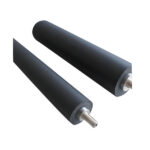
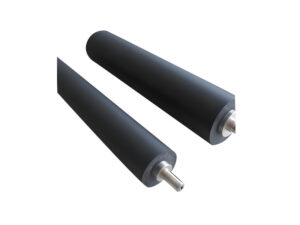
• Light rubber covering: Primarily used to prevent materials (such as moist substances) from adhering to the surface of conveyor belts and rollers, reduce wear, and to some extent improve traction. It is a commonly used type of rubber covering for idler rollers.
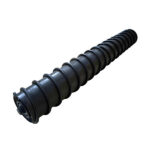
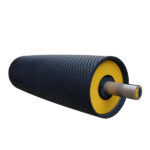
• Herringbone/Diamond Rubber Coating: Rarely used on deflection rollers, unless in extremely wet and slippery special operating conditions where auxiliary traction is required.
3. Bearings and Seals: High-quality self-aligning roller bearings and multi-stage labyrinth seals are employed to effectively prevent the ingress of dust and moisture, ensuring that the drum remains flexible even in harsh environments and extending its service life.
4. Design by functional classification:
• 180° reversing roller: Used at the head or tail of a conveyor.
• 90° deflection roller: Used in vertical tensioning devices.
• ≤45° deflection roller: Used for fine adjustment of guidance in the conveyor line.
Conveyor Belt Supporting Design Features
The coordination between the redirecting roller and the conveyor belt is key to ensuring its service life.
• Roller diameter: Must be matched to the type of conveyor belt carcass and the jointing method. A roller diameter that is too small can cause excessive bending of the conveyor belt’s reinforcing materials (steel cords or fabrics), leading to premature fatigue damage. As a general rule, the roller diameter should be ≥ the conveyor belt’s minimum allowable roller diameter.
• For moderate misalignment: The installation of all deflection rollers must be strictly perpendicular to the conveyor’s centerline; otherwise, it will become a major factor causing the conveyor belt to deviate.
• Surface smoothness: The roller surface must be smooth and flat to prevent damage to conveyor belt joints or belt surfaces caused by uneven welds or dents in the cylinder shell.
Features and Advantages
1. Precise guidance and stable operation: Accurate manufacturing and balancing ensure smooth rotation of the roller, effectively guide the conveyor belt, prevent deviation, and guarantee stable system operation.
2. High rigidity and durability: An optimized structural design and high-quality materials ensure that the product can withstand significant conveyor belt tension, exhibit excellent resistance to deformation, and have a long service life.
3. Effectively increases the wrap angle: When used as an increasing-surface roller, it can significantly increase the wrap angle of the drive roller, thereby enhancing the overall system’s traction capability.
4. Flexible Layout: Enables conveyor system designs to break free from straight-line constraints and meet complex process requirements such as turning and lifting.
5. Low maintenance costs: The structure is simple and has a low failure rate. High-quality bearings and sealing designs significantly extend the maintenance intervals.
6. Protect the conveyor belt: A smooth surface—especially on rubber-covered rollers—can reduce wear on the conveyor belt and provide protection, particularly at the joint areas.